
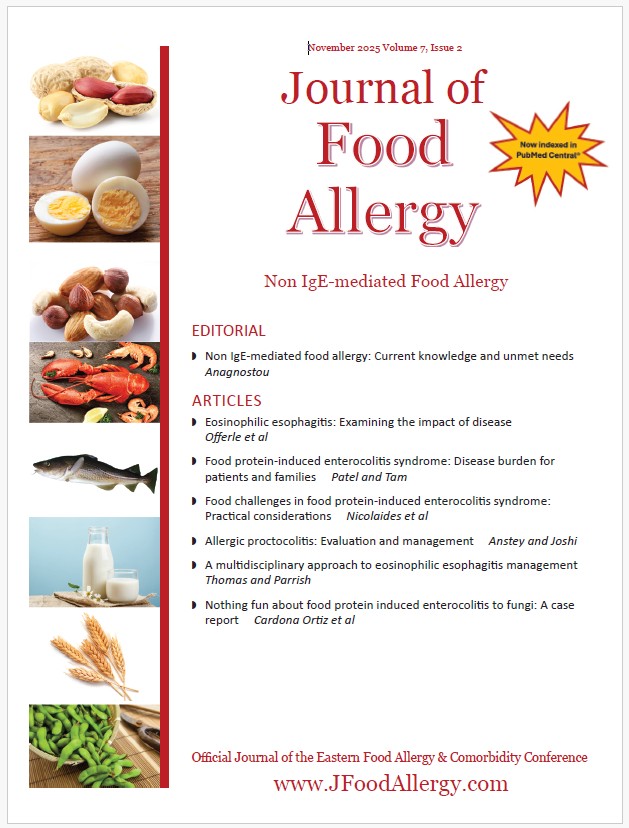
About this journal

The Journal of Food Allergy (JFA) is a peer-reviewed, open-access publication, indexed in PubMed Central, dedicated to disseminating up-to-date information on advancements and innovations in the knowledge and practice of food allergy and associated allergic diseases. The aim of JFA is to support  practicing clinicians and all healthcare professionals entrusted with patient food allergy care. Its primary readership includes healthcare professionals specializing in food allergy. The scope of JFA is to publish articles with a predominantly clinical focus that have the potential to impact patient care outcomes. It welcomes the submission of original works, including peer-reviewed original research, review articles, and clinical trial results. As the official journal of the Eastern Food Allergy & Comorbidity Conference (EFACC),  JFA also publishes content from EFACC poster sessions and review articles from EFACC lectures

Open access statement: The Journal of Food Allergy is disseminated under a comprehensive open‑access framework, ensuring that all published content is made available to readers and their affiliated institutions without financial, technical, or administrative barriers. All materials appearing in the journal are licensed under the Creative Commons Attribution–NonCommercial–NoDerivatives 4.0 International (CC BY‑NC‑ND 4.0) License. This license authorizes users to reproduce and redistribute the work in any medium or format, provided such use is strictly noncommercial, the original authors and source are duly acknowledged, and a link to the license (https://creativecommons.org/licenses/by-nc-nd/4.0/) is included. The creation of adaptations, modifications, or derivative works is expressly prohibited under these terms. This licensing structure is intended to promote broad dissemination of scholarly content while preserving the integrity of the original work and ensuring appropriate attribution

Key features

Open access statement: The Journal of Food Allergy is disseminated under a comprehensive open‑access framework, ensuring that all published content is made available to readers and their affiliated institutions without financial, technical, or...

Edited by Aikaterini Anagnostou, M.D.

Eastern Food Allergy & Comorbidity Conference January 7-10, 2027 The Eau Palm Beach ~ Palm Beach, Florida

Targeted to clinicians

Eastern Food Allergy & Comorbidity Conference January 7-10, 2027 The Eau Palm Beach ~ Palm Beach, Florida

Peer-reviewed by Allergy/Immunology clinicians

Eastern Food Allergy & Comorbidity Conference January 7-10, 2027 The Eau Palm Beach ~ Palm Beach, Florida

Indexed by PubMed Central®

Eastern Food Allergy & Comorbidity Conference January 7-10, 2027 The Eau Palm Beach ~ Palm Beach, Florida

Rapid Publication: No APC’s and No backlog

Eastern Food Allergy & Comorbidity Conference January 7-10, 2027 The Eau Palm Beach ~ Palm Beach, Florida

Wide e-distribution: >21,000 eTOC recipients

Eastern Food Allergy & Comorbidity Conference January 7-10, 2027 The Eau Palm Beach ~ Palm Beach, Florida

Expedited services available

Eastern Food Allergy & Comorbidity Conference January 7-10, 2027 The Eau Palm Beach ~ Palm Beach, Florida

Manuscript types: Review Articles and Original Research

Content online at:

Open Access under Creative Commons Attribution License: CC by NC-ND 4.0

Content online at:

Content online at:

Eastern Food Allergy & Comorbidity Conference

Content online at:January 7-10, 2027

Content online at:The Eau Palm Beach ~ Palm Beach, Florida

EFACC is a well-attended regional allergy conference that plans and conducts annual clinical and scientific CME meetings on food allergy and comorbid allergic diseases in a learning environment that blends the informality of small regional conferences with the cutting-edge science of national conferences. Its educational goal is to share clinically useful information that improves the diagnostic accuracy and effectiveness of treatments with practitioners who treat patients with food allergies. Its content is most relevant to allergy specialists, but attendance is open to all physicians, nurse practitioners, and physician assistants.

  • Frequency: Annually in January
  • CMEs: 16 – 20
  • Speakers: ~ 20
  • Format: live (only), lectures, debates, problem-based learning, panel discussions, poster sessions
  • Registrants: 200-250
  • Promotional opportunities (exhibit hall, product theatres, sponsorships)
Content online at:

Advertise in this journal